


Exhibit 1. Translatio Symonis Ianuensis interprete. Abraam iudeo tortuosiensi de arabico in latinum. Venetiis: Reynaldus de Novimagio. From: Serapion, Liber aggregatus in medicinis simplicibus (Venetiis: Reynaldus de Novimagio, 1479), London, UCL Special Collections, HNHS Library, INCUNABULA QUARTO 6 m,

The Book of Simple Medicaments is attributed to ‘Serapion the Younger’ in the 12th or 13th century, although almost nothing is known about the author. His work on the medicinal properties of plants is thought to have been written in Arabic and was intended to be read by physicians and apothecaries. Translated into Latin in the late 13th century it was widely read in Europe, even before the mid-15th century introduction of the moveable-type printing press. There are no illustrations, but the printing is a handsome combination of black text with decorative capital letters in red and blue that were added by hand. The 'incunable' is bound in a plain parchment binding with five other, short medical texts, all printed in Italy during the 1480s.
Exhibit 2. Ocimastrum Wild Basilg. From: Fuchs, L., De historia stirpium commentarii insignes
(Basileae: In officina Isingriniana, 1542), London, UCL Special Collections, HNHS Library, Strong Room HNHS Folio 1542 F8
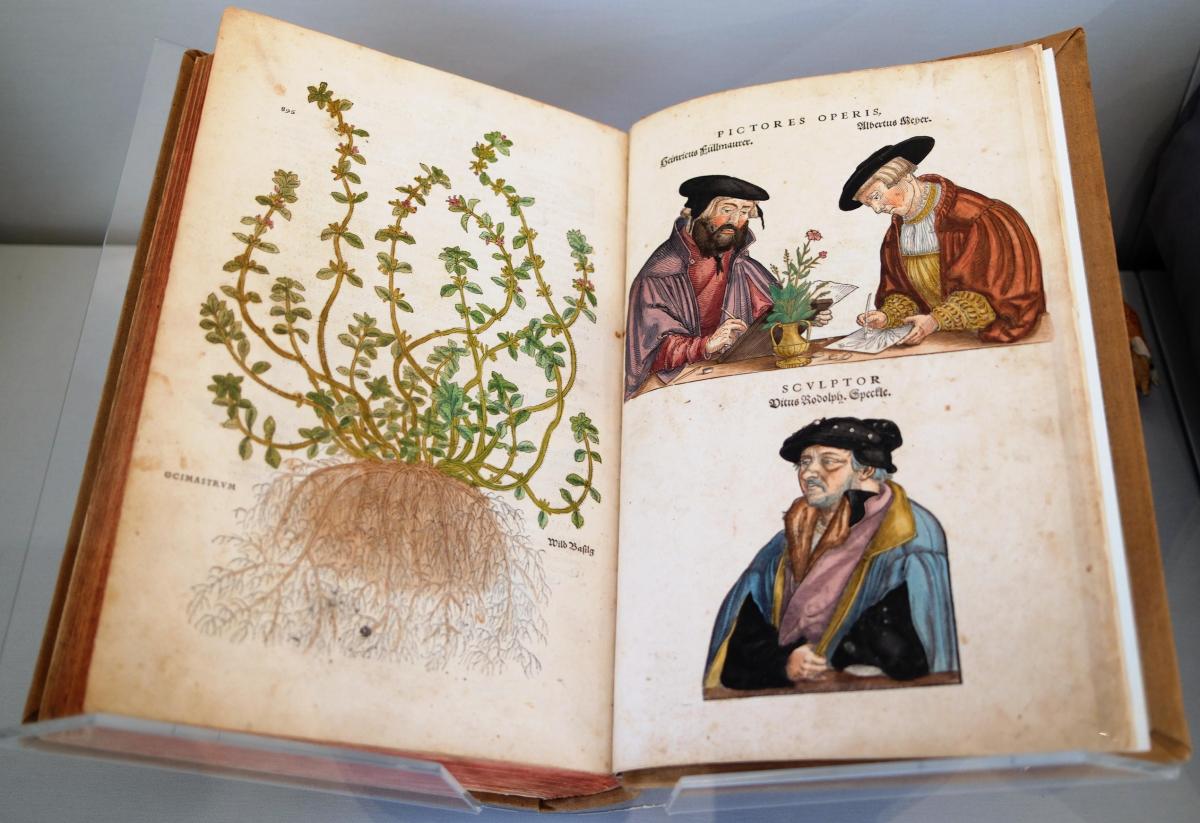 The Bavarian physician Leonhart Fuchs published his remarkable volume on ‘notable’ herbal plants in Basel in 1542. It describes almost 500 species, with their medicinal uses, and contains an even larger number of original woodcut illustrations. Research has found that more than a hundred of the plants included were being described and illustrated for the first time. Fuchs spent the decade before publication acquiring plants from across Europe for his garden and creating a large botanical library. He hired two painters and a highly-skilled engraver, Heinrich Fullmaurer, Albert Meyer, and Veit Rudolf Speckle, to illustrate his book. Hand-colouring of the illustrations makes the first edition owned by the HNHS particularly impressive. A notable feature of the book is that the woodcuts include pictures of Fuchs himself (not exhibited, but see below) and his production team (shown on the right of the exhibited page) as well as the plants, which were drawn from life. The Ocimastrum or Wild Basilg shown on the left-hand page is known in modern times as Basil Thyme (Clinopodium acinos).
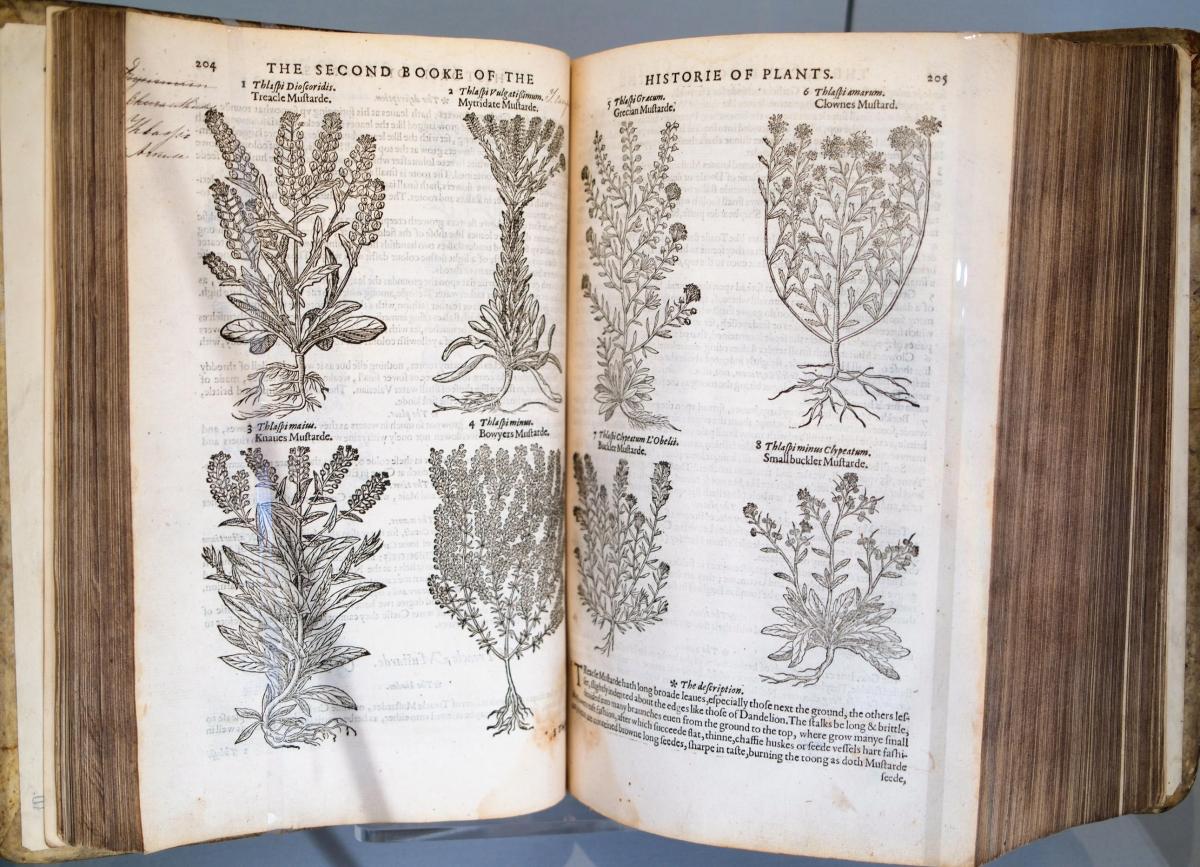 Exhibit 3. Mustard plants. From: Gerard, J. et al. (1597) The Herball Or Generall Historie of Plantes (London: by Iohn Norton, 1597), London, UCL Special Collections, HNHS Library, Strong Room HNHS Folio 1633 G2,
John Gerard (1545-1612) was a barber-surgeon and horticulturalist who gardened in Holborn, London. His Herball, published in 1597, was a substantial undertaking describing more than a thousand plants over 1,484 pages, with woodblock illustrations (photo 5). Much of the text is a pirated third-party translation into English of Stirpium historae pemptades sex published by the Flemish physician and botanist Rembert Dodoens in 1583. Most of the illustrations were imported from a German publisher. Gerard added descriptions of plants found in the English countryside, including 180 species that had not previously been described in print. Some plants from the Americas were included, notably the first description in English of the potato. Gerard described many uses for different varieties of mustard (shown in exhibited pages), including a sauce, a toothache remedy, and a sneezing powder
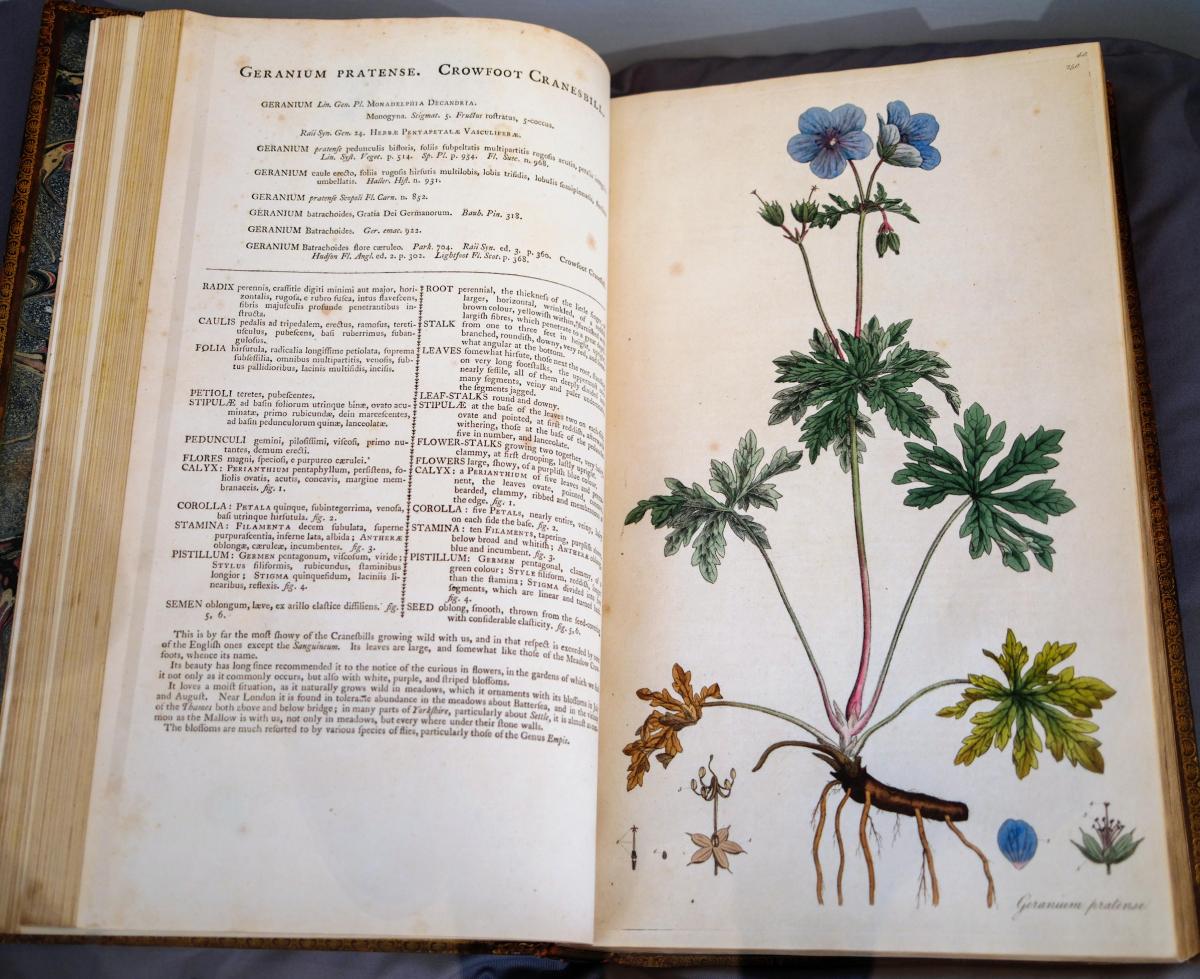 Exhibit 4. Geranium Pratense Crowfoot (or Meadow) Cranesbill. From Curtis (1777-1798) Flora Londoniensis. Volume 2. HNHS SMI
Flora Londinensis is an exceptionally large book published by William Curtis in six extensive volumes. The hand-coloured copperplate plates were prepared by botanical artists who included James Sowerby (the subsequent creator of English Botany, also exhibited) . The full title is 'Flora Londinensis: or, plates and descriptions of such plants as grow wild in the environs of London: with their places of growth, and times of flowering, their several names according to Linnæus and other authors: with a particular description of each plant in Latin and English. To which are added, their several uses in medicine, agriculture, rural œconomy and other arts.' Until Flora Londiniensis was published, botany books had been written for scientists, physicians and herbalists, but this book with its beautiful illustrations was intended to appeal to fashionable society as well as experts.. .Curtis began with the wild plants from the immediate vicinity of London, but limited sales meant his plans to extend its range further were never realised. However, in time the individual copper engravings taken from the book became collector's items for framing and wall-display. By publishing at folio size Curtis was able to show plants at life size. The colouring and notes enable accurate plant identification – though definitely not in the field!
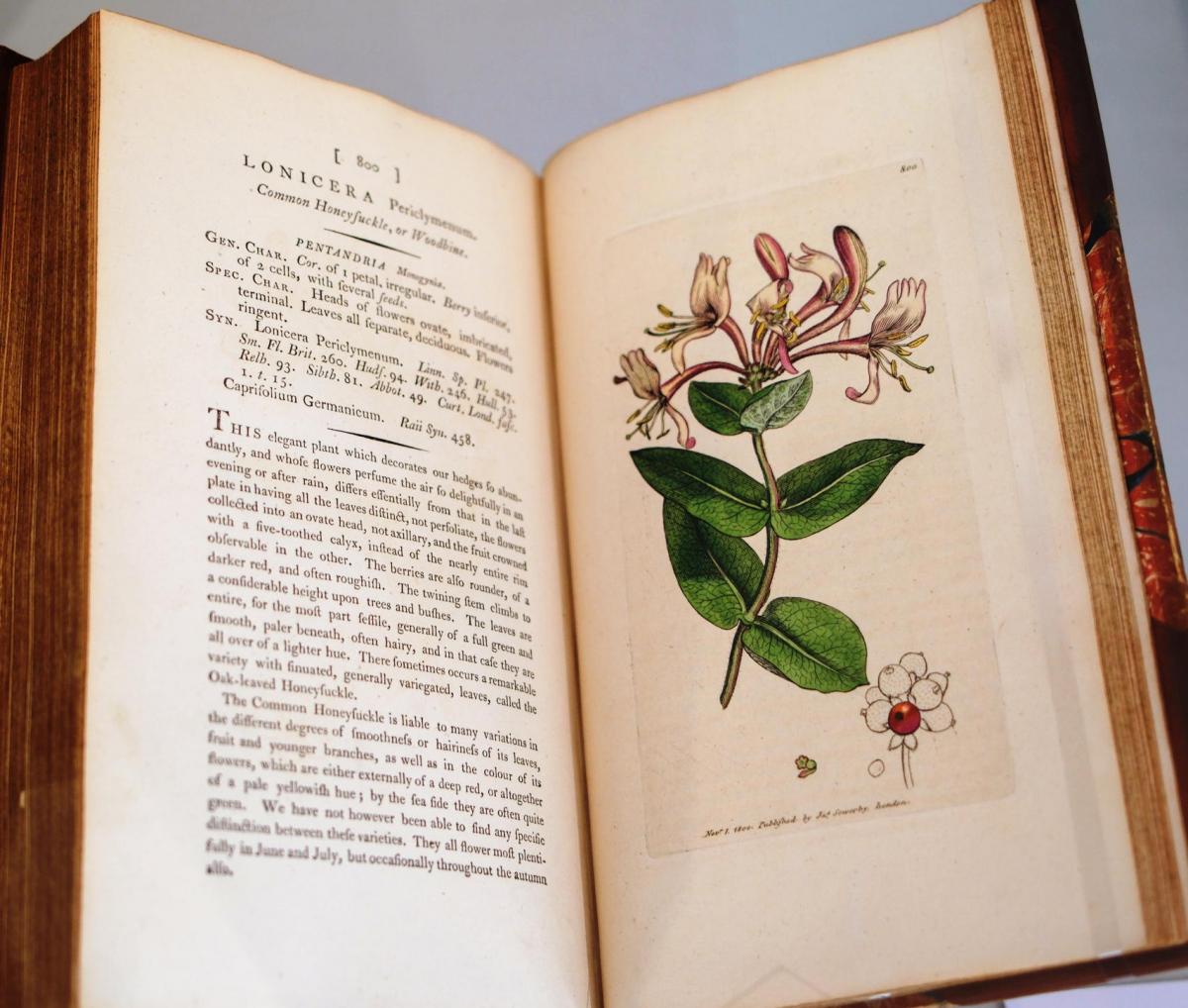 Exhibit 5 Lonicera Periclymenum, Common Honeysuckle or Woodbine. From Smith, J. E. et al. (1790) English botany, or, Coloured figures of British plants, with their essential characters, synonyms, and places of growth : To which will be added, occasional remarks / By James Sowerby, F.L.S. London: Printed for the author, by J. Davis; and sold at no. 2, Mead Place, near the Asylum; by Messrs. White, booksellers, Fleet Street; Johnson, St. Paul’s Church Yard; Dilly, in the Poultry; and by all booksellers &c. in town and country. 20 vols HNHS SMI
English Botany was spectacularly ambitious publishing enterprise conceived by James Sowerby, a botanical illustrator and natural history enthusiast. It was issued in 267 monthly parts over 23 years from 1790 to 1814, by which time it consisted of 36 volumes. Sir James Edward Smith, founder of the Linnaen Society, provided the plant descriptions and, in time, took lead-authorship of the series, although it remained popularly known as 'Sowerby's Botany'. The complete work comprised 2,592 hand-coloured, copper-plate engravings, including three fold-outs, each with a single page of text. It grew into the most comprehensive, illustrated flora of Great Britain available and included mosses and lichens as well as vascular plants.
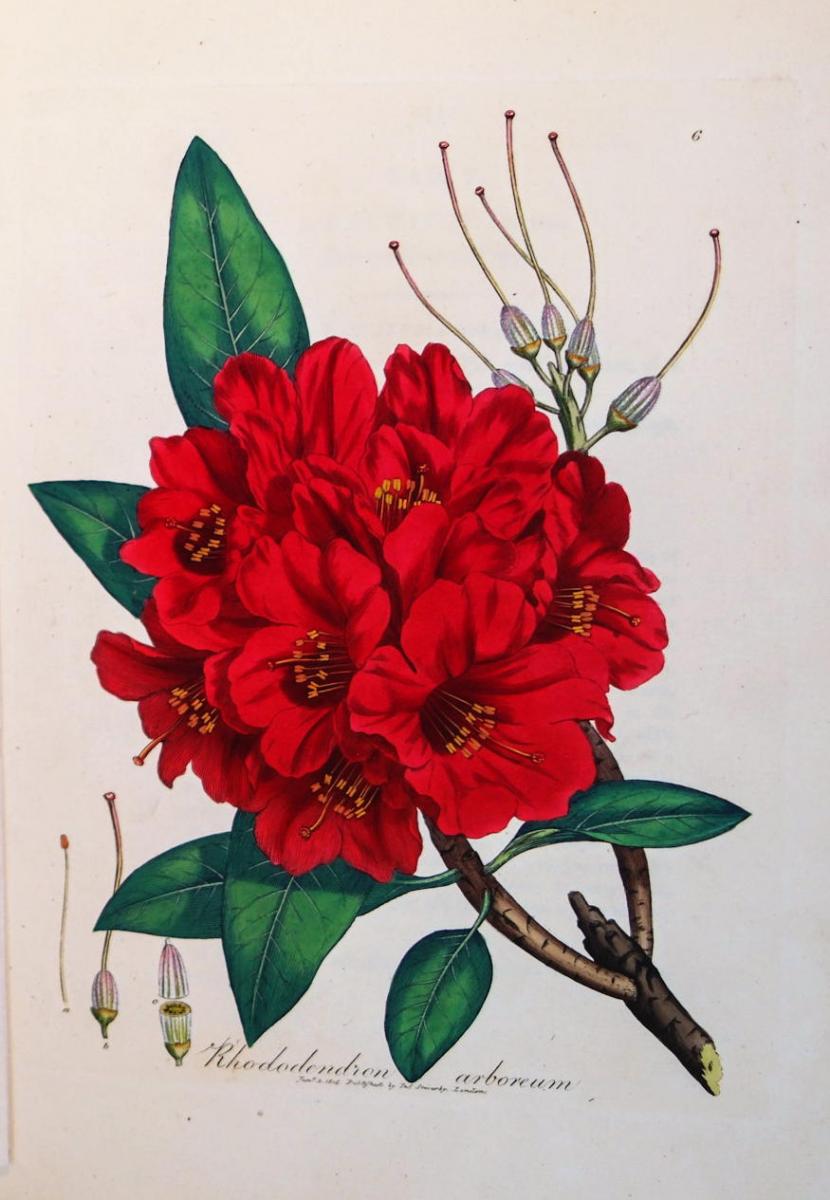 Exhibit 6. Rhododendron. From Smith, Sir James Edward (1759-1828). Exotic Botany: consisting of coloured figures and scientific descriptions of such new, beautiful, or rare plants as are worthy of cultivation in the gardens of Britain. London: R. Taylor, sold by James Sowerby [and others] HNHS QUARTOS SMI.
Smith was a leading English botanist who founded the Linnean Society in London. He was also botanical tutor to the Royal Family. The lavishly illustrated Exotic Botany was a second collaboration with the celebrated botanical illustrator James Sowerby. It was published in 1804-1805 'to introduce to the curious cultivator plants worthy of his acquisition from all parts of the globe, and to teach those who have correspondents abroad what to inquire for.' Rhododendron species are widely distributed around the world, but especially diverse in east Asia. Evergreen varieties with copious, bright flowers became hugely popular in Victorian shrubberies. Smith and Sowerby based their illustrations on their own specimen collections and on drawings provided by travellers.
Six centuries of plants: the HNHS collection of rare botany books
by Erika Delbecque and David Utting
(Article originally published in the Hertfordshire Naturalist 2024)
Age is relative. When the Hertfordshire Natural History Society celebrates its 150th anniversary next year, it will still find itself almost 400 years younger than the oldest volume in its own, remarkable library of historic botany books.
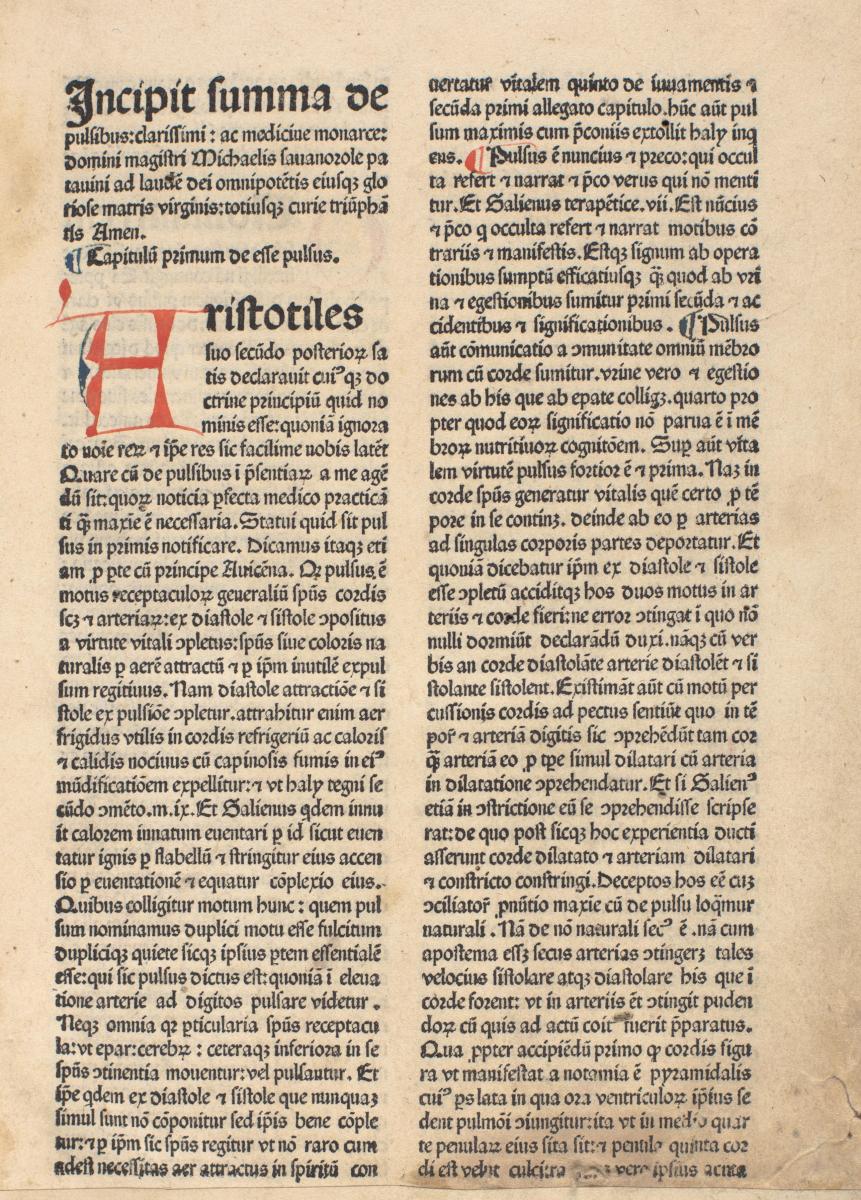
The herbal medicine book in question dates from 1479 which makes it an ‘incunable’ – a book printed before the 16th century. It was produced in Venice and is the Latin translation of a Book of Simple Medicaments that had been penned in Arabic more than two centuries earlier. There are no illustrations, but the printing is a handsome combination of black text with decorative capital letters in red and blue that were added by hand (Photo 1). It is bound in a plain parchment binding alongside five short medical texts, all printed in Italy during the 1480s.
These and the selection of other rare and valuable books described in this article are jewels in the crown of an HNHS catalogue that altogether comprises more than 1,300 natural history volumes as well as hundreds of periodicals. Since 1935, they have been kept, with expert care, by the Library at University College London (UCL).
Foremost in explaining how such treasures come to be in the Society’s ownership is the name of the 19th century Hertfordshire botanist A. Reginald Pryor (1839-1881). A founder member in 1875 of the Watford Natural History Society and Hertfordshire Field Club (the Society changed its name in 1879 to Hertfordshire Natural History Society and Field Club) and an early Vice-President, his manuscript notebooks were the basis for a Flora of Hertfordshire, published in 1887 (Photo 2). The son of a Hatfield brewer, he suffered poor health for much of his life. His book was completed and edited by others six years after an untimely death. A. R. Pryor bequeathed to the HNHS all his botanical books, manuscripts and collections, together with £100 (equivalent to nearly £15,000 today) “to enable the Society to keep and preserve the same as one collection…”. (HNHS Council, 1883)
His 400 books included volumes inherited from his grandfather, John Izard Pryor. They were added to 40 botany books donated in 1880 by the widow of the late Rev. Robert Holden Webb, co-author of Flora Hertfordiensis (1849). Then, in 1882, the Society acquired 90 books from Isaac Brown, another Hertfordshire botanist as well as noted astronomer and educationist. Previously head of his own Quaker school in Hitchin, he was living in Cumbria at the time of his donation, which brought him honorary HNHS membership.
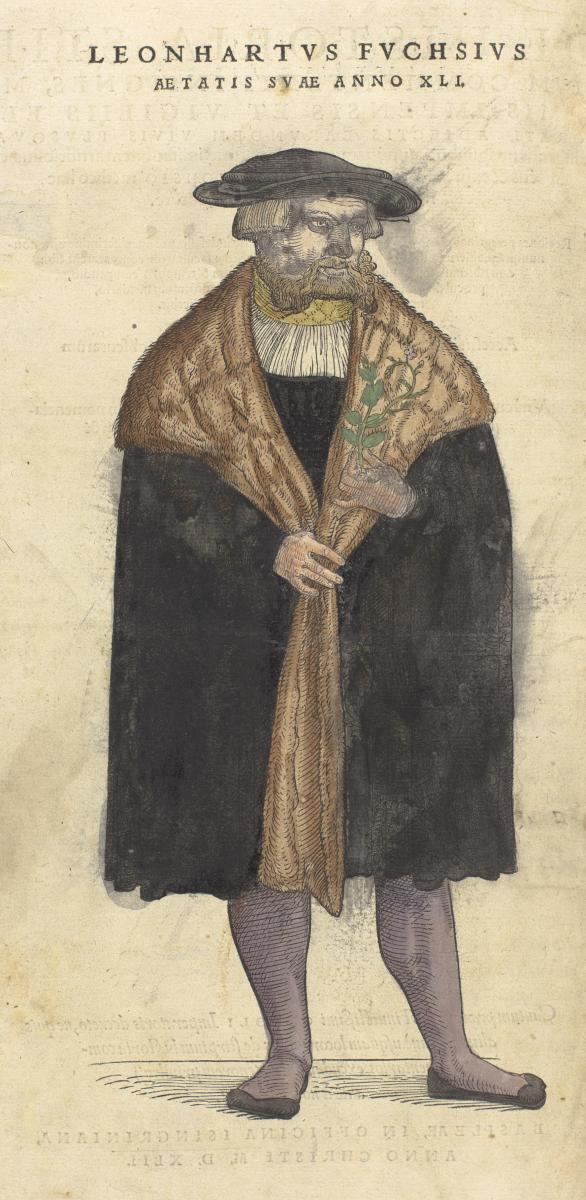 Curiously, none of a total of seven incunables in the collection give any indication of having belonged to either the Pryor family, Webb or Brown. In other cases, bookplates show which books came from which donor. These include Pryor’s spectacular 16th century edition of De Historia Stirpium Commentarii Insignes (Notable Commentaries on the History of Plants) by Leonhart Fuchs with its painstakingly hand-coloured woodcuts.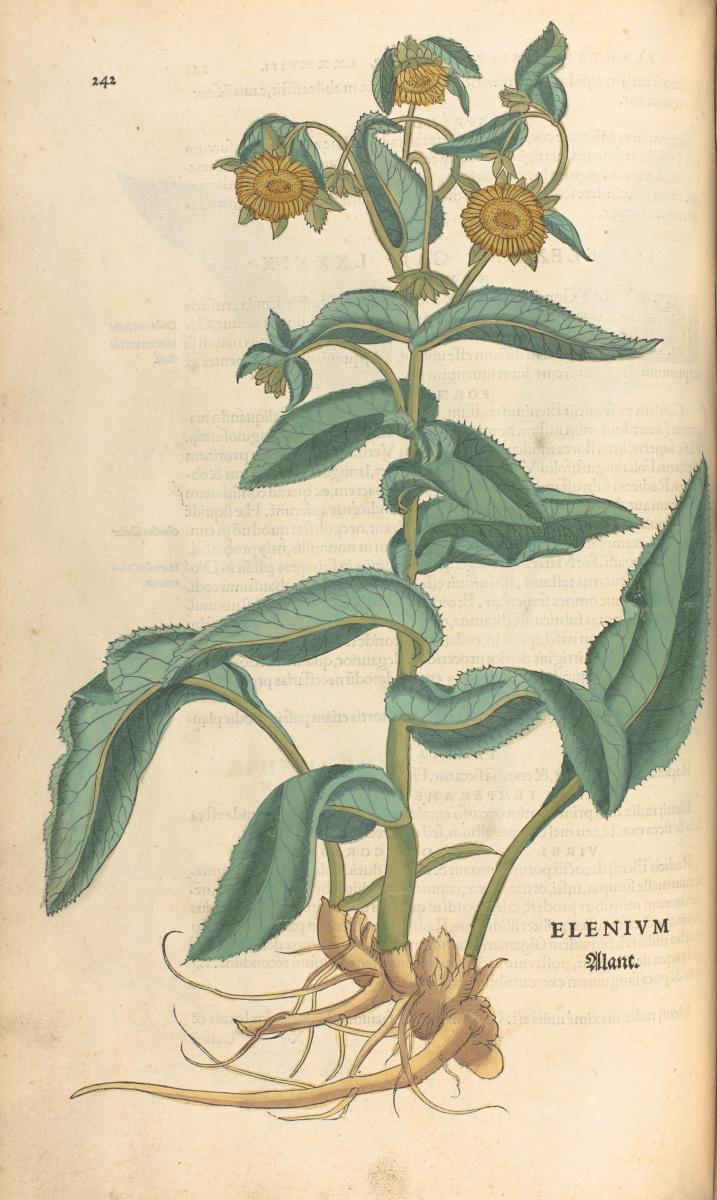
The Society’s rare books were described by a past HNHS Secretary as “probably the third best collection of old botanical works in the country” (Kingsbury, 1991). When he lectured at the Society’s Centenary Meeting in 1975, Richard Freeman, a UCL zoologist and natural history bibliographer was unenthusiastic about the collection’s 120 volumes on non-plant natural history and zoology. But he declared the books on systematic and field botany to be “superb”. To which he added:
“I could give a course in the history of botany and barely have to show the students any books that were not contained here. The collection makes no attempt at completeness, but almost every time one chooses a key example to illustrate some point in historical advances, there the book is.” (Freeman, 1975)
This article, by focusing on visually attractive volumes, risks leaving a misleading impression that the HNHS rare botany books abound in beautiful and colourful illustrations. This is not generally the case, leading Freeman (1975) to observe that Exotic Botany published in 1804 by Sir James Edward Smith, founder President of the Linnean Society, is one of the few that feature lavish, colour plates. In truth, many of the books (Baker,1989) that were lodged with UCL before the Second World War were of strictly utilitarian interest to natural historians, equipping the Society with its ‘working’ library. Or what, by then, remained of it.
From 1895 the Society’s expanding collection had been stored (with unsatisfactory access) in the former board room of Watford Urban District Council’s waterworks (HNHS Council, 1898). By 1925 it comprised several thousand books and journals. These were briefly moved to a furniture repository before being installed in 1927 in Watford’s new public library in Hempstead Road (HNHS Proceedings, 1929). Pressures on shelf space meant hundreds of publications deemed less useful or valuable were destroyed or transferred elsewhere (Kingsbury, 1991).
In 1934, when Watford Library intimated that they could not house the remaining collection for much longer, the HNHS committee looked for a permanent solution. Two leading figures, Sir Edward Salisbury and Professor A.E. (Arthur) Boycott, were instrumental in reaching a permanent loan agreement with UCL. This specified that HNHS members would have access to both the HNHS books and to the rest of the UCL library collections, and that the Pryor Bequest would be kept together as a special collection. Apart from surviving a bomb that fell on UCL in 1940 and being subsequently moved out of the college for the remainder of the War, the collection’s recent history has been uneventful.
The terms of the loan agreement still apply today: HNHS members are entitled to join UCL Libraries and borrow books (www.ucl.ac.uk/library/using-library/membership-services/external-users/l...). The process can be complete online provided they request an uploadable letter from the HNHS Secretary, confirming paid-up membership. Anyone can view the rare books from the HNHS Library at one of the reading rooms run by UCL Special Collections, the department that looks after UCL’s centrally held archives, rare books and records (www.ucl.ac.uk/library/collections/special-collections/visiting-us). The HNHS rare books are securely housed in a climate-controlled store, and they are regularly used in classes and events for UCL’s students, the academic community, community groups and school groups from the surrounding areas.
A few of the most impressive examples, including Fuchs’s De Historia Stirpium, were exhibited at UCL for one afternoon only in July 2019. However, books from the collection will be on public display at St Albans Museum between March and July 2025 as part of an exhibition to celebrate the Society’s 150th anniversary. It promises to be a rare treat.
Erika Delbecque is Head of Rare Books at University College London. David Utting is the Secretary of Hertfordshire Natural History Society
References
Baker, P. (1991) List of Books in the library of the Hertfordshire Natural History Society (held at London University). Transactions of the Hertfordshire Natural History Society 30: 575-594 Appendix 2.
Britten, J. (1881) In Memory of Reginald Pryor. Transactions of the Hertfordshire Natural History Society and Field Club 1: 265-267 numbered as 1-3 (Re-printed from the Journal of Botany, September 1881).
Freeman, R.B. (1975) The Society’s Library. Transactions of the Hertfordshire Natural History Society and Field Club 27: 348-354.
HNHS Council (1883) Report of the Council for 1881. Transactions of the Hertfordshire Natural History Society and Field Club II: xvi-xvii.
HNHS Council (1884) Report of the Council for 1882. Transactions of the Hertfordshire Natural History Society and Field Club II: xlvi-xlvii.
HNHS Council (1898) Report of the Council for the Year 1895. Transactions of the Hertfordshire Natural History Society and Field Club 9: xxiii.
HNHS Proceedings (1929) Session 1925-26. Transactions of the Hertfordshire Natural History Society and Field Club 18: xxxvi.
Kingsbury, P.A. (1991) Annotated Index to Transactions of Watford Natural History Society Volumes I and II. and Transactions of Hertfordshire Natural History Society Volumes 1-30 (1875-1990). Transactions of the Hertfordshire Natural History Society 30: 549 Appendix 1.
Madge, B. (2001) Elizabeth Blackwell – the forgotten herbalist? Health Information Libraries Journal 18: 144-152.
Pryor, R.A. (the late) and Jackson B.D. (ed.) (1887) A flora of Hertfordshire. London: Gurney & Jackson and Hertford: Stephen Austin.
Smith, J.E. (1804) Exotic Botany. London: R. Taylor & Co.
Webb, Rev. R.H. and Coleman, Rev. W.H. (1849) Flora Hertfordiensis: or A Catalogue of Plants found in the County of Hertford, with the Stations of the Rarer Species. London: William Pamplin and Hertford: Stephen Austin.