


Join us on a nature walk around St Albans. Follow our trail to discover birds, bees, butterflies, dragonflies and other wonderful wildlife...
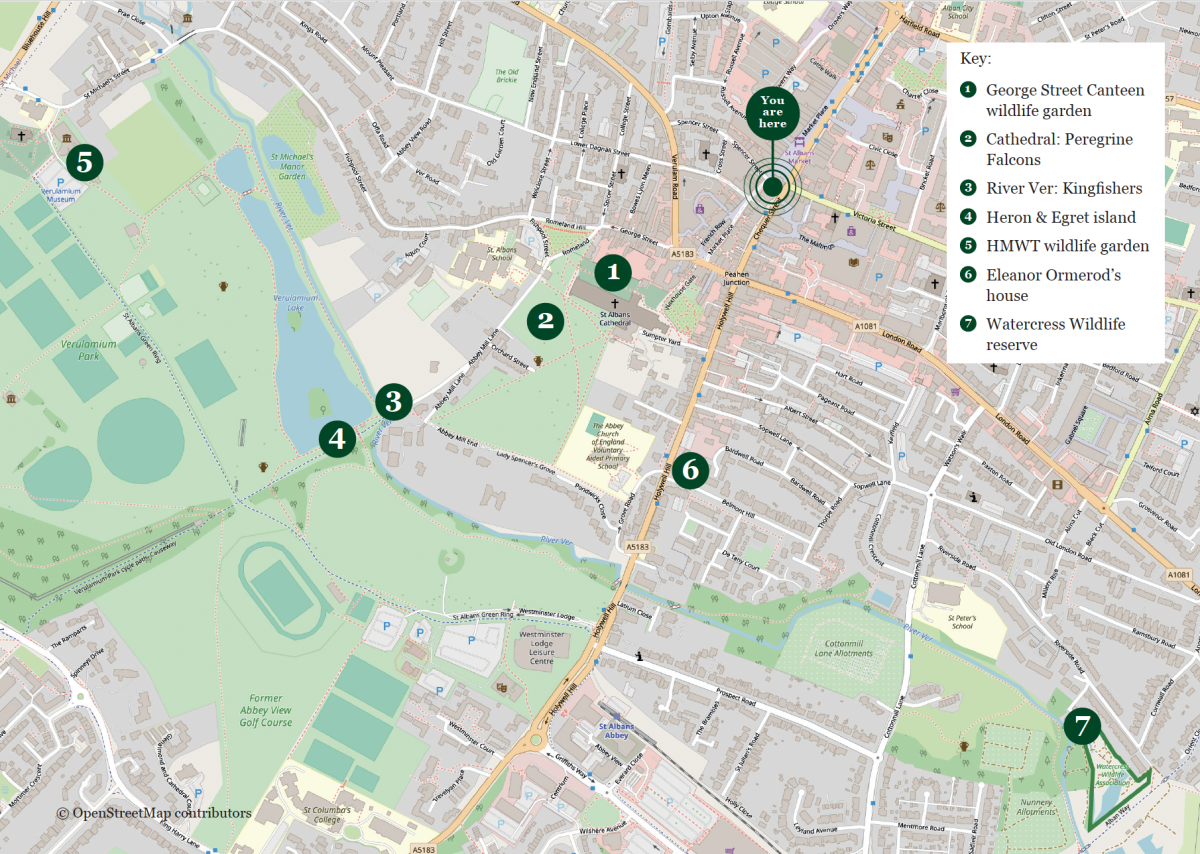 Starting in St Albans market place, look up and listen. You might see a Red Kite, or hear the loud ‘chiz-wick!’ calls of streetwise Pied Wagtails…Then use our map to find:
1) George Street Canteen wildlife garden (pond, mini-meadow, hedgerows and bug ‘hotels’) 8.30am – 4pm daily. 4 mins*
2) St Albans Cathedral’s Peregrine Falcons (south side). 5 mins*
Take a look at the Cathedral roof and other high vantage points.
If you are walking down to the Verulamium Park lake watch and listen for garden birds, including Great Tit, Blue Tit, Coal Tit, Blackbird, Robin and Wren. Also Jackdaws, Carrion Crows and Magpies.
3) Kingfisher perches along the River Ver. 10 mins*
Overhanging branches near the Olde Fighting Cocks pub are a favourite fishing place, but the birds often be there. Kingfishers show brilliant blue when perched, but sometimes in flight may look more like a big, brown bumblebee!
4) Herons and Egrets on the islands in the lake (ducks, geese, gulls, too). 11 mins*
Grey Herons and Little Egrets nest on the southern island. Also watch out for Moorhens, Coots, Mute Swans, Canada Geese, Greylag Geese, Mallard and Gadwall Ducks on the water and banks.
5) Herts & Middlesex Wildlife Trust’s wildlife garden (bees, beetles butterflies, dragonflies, birds, wildflowers and pond life). 9am – 4pm (closed Wednesday am). 18 mins*
6) Eleanor Ormerod’s house (an HNHS plaque commemorates the Victorian insect expert). 8 mins*
Eleanor Ormerod (1828-1901) was an international authority on farm pests in an era when few women could consider becoming a scientist. Independently wealthy, her self-learned interest in insects began when growing up on an estate in Cheshire. She studied at the Royal Botanic Gardens at Kew, encouraged by their eminent director, Sir Joseph Hooker.
She helped the Royal Horticultural Society to assemble a specimen collection of insect pests and received their Flora Medal for her work. The first of her annual ‘Notes on Injurious Insects’, was read at an 1878 meeting of the HNHS where she became an honorary member and the first woman county recorder. She was subsequently appointed Consulting Entomologist to the Royal Agricultural Society and was the first woman awarded an honorary degree by the University of Edinburgh.
Eleanor Ormerod once hastened to a farm near Hertford to identify pupae of the Hessian Fly. This introduced species had already caused massive destruction to cereals in the United States. After studying the fly’s life-cycle, she was able to publish prompt and largely reassuring advice to British farmers. She also investigated poisonous skin slime produced by Great-crested Newts by putting one between her own teeth. The result was “much foam and violent spasmodic action” around her mouth, followed by a persistent headache and shivering!
With her sister Georgiana, a scientific illustrator, she lived at Torrington Hall on Holywell Hill in St Albans from 1887. A plaque placed there by the HNHS commemorates her remarkable life.
7) Watercress Wildlife Local Nature Reserve (a hidden gem with birds, butterflies, dragonflies, frogs and other water life). 9am to dusk / 8pm. 20 mins*
* Walking time from St Albans Museum