


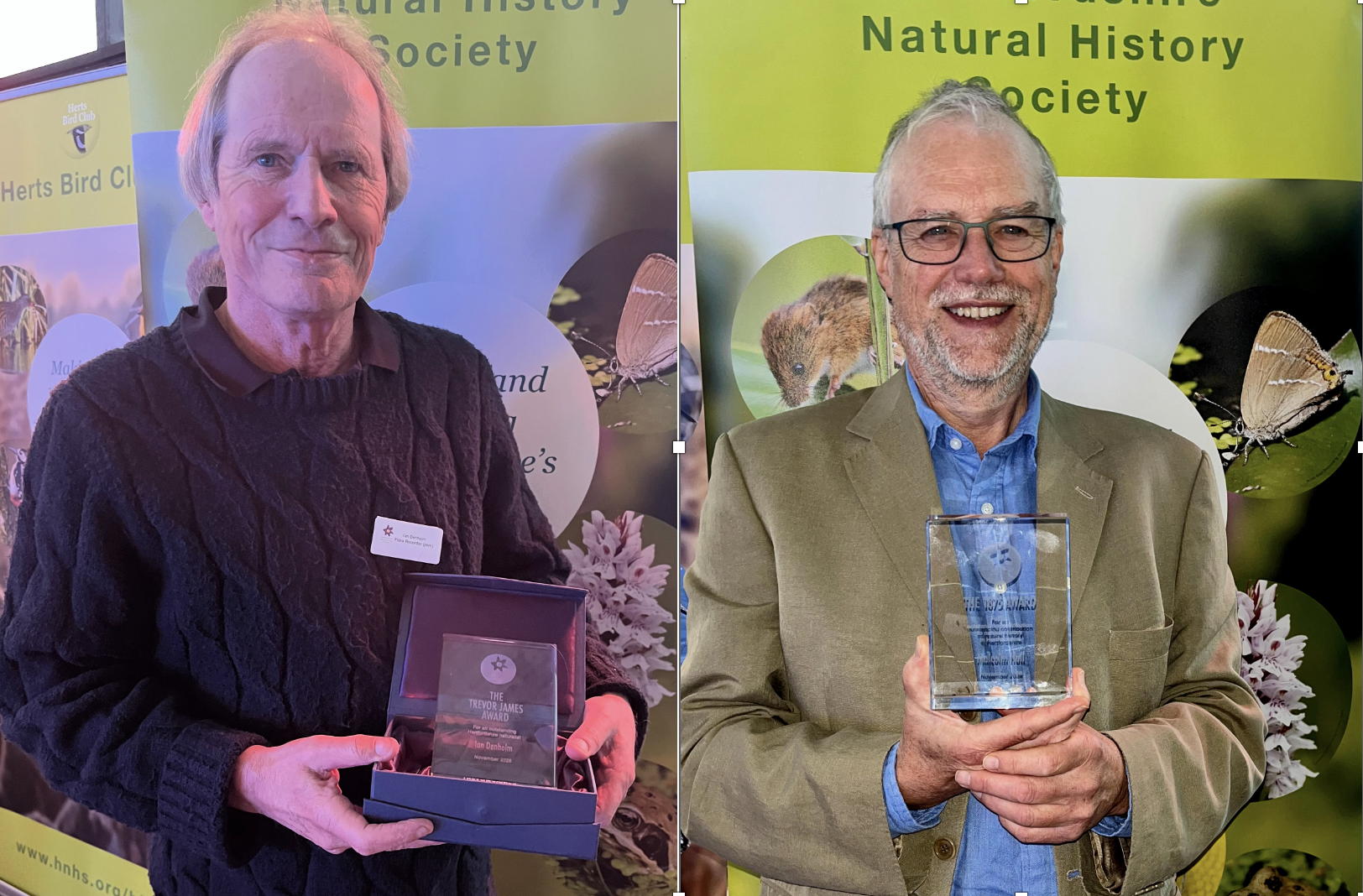
Congratulations to our 2026 HNHS Award winners: Ian Denholm (left), presented with the Trevor James Award for an outstanding Hertfordshire naturalist and Malcolm Hull, who received the 1875 Award for an outstanding contribution to Hertfordshire natural history.
Ian's award recognises a 40-year contribution to knowledge about the county's plants and wildlife, including his particular expertise in botany that has made him a national authority on orchids. Malcolm is the Chair of the Herts and Middlesex branch of Butterfly Conservation since 2015 and whose important contribution to butterfly recording has been matched by enthusiasm for sharing his knowledge with policy makers and community conservation groups.
The awards were presented at the Autumn Conference on Saturday 7 November at the Affinity Water offices in Hatfield, attended by almost 80 members and friends. Further website information about both winners and can be found on our HNHS Awards pages.
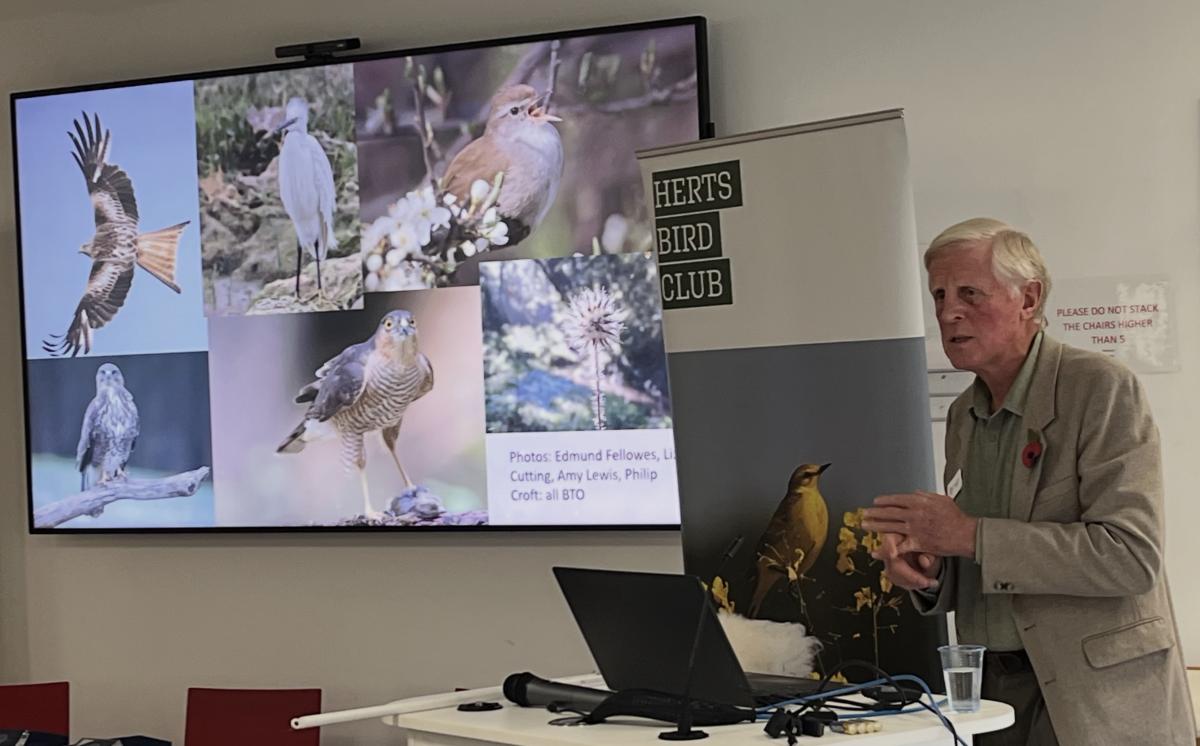 The conference enjoyed a talk by Martin Ketcher reflecting on a remarkable 46 years as voluntary warden of the Purwell Nine Springs reserve on the River Hiz near Hitchin. It ranged from 1980, when the, then, Herts and Middlesex Trust for Conservation presented him with two pitchforks on appointment as warden, to early 2026 when he reached a decision to stand down.
Martin Ketcher, speaking at the conference (©David Utting)
During that time, the challenges included implementing a management response to rising water levels caused by stream damning just outside the protected area and preventing the reserve being used as a community rubbish dump. Meadow mowing and ditch-digging by volunteers, using increasingly heavy-duty equipment, was needed to maintain a mosaic of habitats, including watery reed beds suitable for breeding birds.
Although early hopes were disappointed that winter sightings of up to 12 Bearded Tits would lead to a breeding population, monitoring established that the reserve was one of the five most important sites in Hertfordshire for Water Voles. Spraint left by Otters are a regular sign of their presence. The most exotic invasive species discovered growing among three reeds was three Cannabis plants. These were removed by police and incinerated.
A recording of Martin's "personal, social and natural history" can be viewed on the HNHS YouTube site.
The second keynote speaker was Wendy Morrison, director of the Chilterns Heritage and Archaeology community interest company. She argued the case for the detection and protection of pre-historic and other archaeological sites to be treated as a complementary part of nature recovery work. In doing so, she noted that archaeology had been a core study area for the HNHS in the 19th and early 20th centuries, before archaeologists formed their own, specialist groups.
Taking the flood plain of the River Chess as her example, she also demonstrated how archaeological methods, including laser-sensing Light Detection and Ranging (LIDAR), could reveal valuable conservation information, such as the channels formerly used by chalk streams before human intervention. Her involvement in an initiative to extend grassland and create wildlife-friendly scrapes on chalk downland had, conversely, led to a prehistoric burial site being mapped that could otherwise have been unintentionally damaged.
The conference also received updates from HNHS Webmaster Toby Hill on the project to redesign and upgrade the Society's website, and from Roy Woodward, county recorder for dragonflies, on the six-year Hertfordshire survey that will reach its final season in 2027. ( Recordings of these talks are available on the YouTube site)
There was particular interest in the update provided by Alister Leggatt, Environmental Strategy and Delivery Manager at Affinity Water, on Hertfordshire's water resources following high temperatures and extensive drought periods during the summer and September. He was clear that heavy and extensive winter rainfall would be needed to come close to replenishing the chalk aquifers that supply most of the county. (A recording of this talk is available on the YouTube site).
His colleague Louisa Veasey, an Asset Scientist in Affinity's Biodiversity Team, provided an overview of the company's initiatives to support nature recovery, including management of its own 250-hectare land estate. Steps taken included hedge re-planting, pond enhancement, scrub renewal, reed bed. management, Swift-box installations and even the hopeful installation of an Osprey platform.
Louisa also outlined a number of grant schemes and other initiatives for farmers, other landowners and conservation groups, including support for removal of harmful non-native, invasive plants and extending chalk grassland to improve surface water absorption, (A recording of this talk is available on the YouTube site).
Our thanks go to Affinity Water for their continued support for HNHS / Herts Bird Club conferences.
