


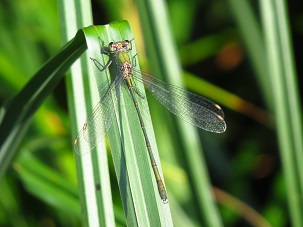
A new species of Damselfly for Hertfordshire, the beautiful Willow Emerald Damselfly, Lestes viridis, was discovered by Darren Bast on the Dragonfly trail at Amwell Nature Reserve on 3rd September. This is the first fully authenticated Hertfordshire record of this species.
Darren tells the story of his find:
"I've been going to Amwell through the summer months with a recently acquired interest in dragons/damsels and bugs in general. This due to the usual quiet birding months we experience.
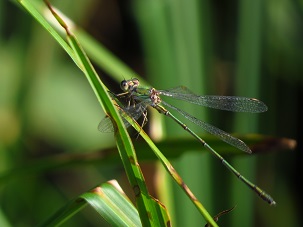 I've had some good sightings and captured most of the dragons/damsels only missing out on the early year ones due to my timings.
On 3rd September I'd done my usual round of, orchard, viewpoint, Tumbling bay, Hollycross, when I sat to review some photos of migrant hawkers I'd just taken. As I looked up at another migrant, a damselfly caught my attention. It looked to me like an emerald so I fired off plenty if shots. I then went back to the viewpoint to show my good friend Ron Cousins who immediately thought it was a Willow Emerald, he took screen shots and emailed them to Barry Reed who confirmed. We thought that the warm easterlies we had experienced recently could have pushed them over from Essex.
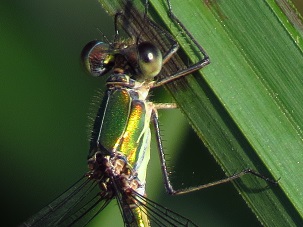
Without these guys confirmation and help I'd have assumed Emerald until I'd got home to upload pictures and review my guidebooks. I emailed Roy Woodward (Herts County Dragonfly Recorder) as soon as I got home and he again confirmed.
The sighting was only possible thanks to Jenny Sherwen, HMWT Amwell warden, keeping the Hollycross lake area open beyond the normal 1st Sept closure date. I've been visiting Amwell about 3 times a week in afternoons, so have put in plenty of hours, getting to know the area and photographing many species. I'm dead chuffed to have found and recorded it and its been worthwhile putting all the hours in over at Amwell."
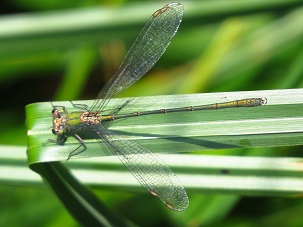
Darren added: "These six photographs are the best, covering most angles and even close up, showing the abdominal spur. They were captured at around 16:00hrs in bright sunlight. The Emerald Willow was aggressively seeing off, other damsels and also migrants hawkers. It kept returning to the same area of goat willow and reed, only 4 feet away from me across a small waterway. I went back later with the others to see if still present but the sun had left the area, so was unable to relocate it."
Roy Woodward, HNHS Dragonfly Recorder, explained:
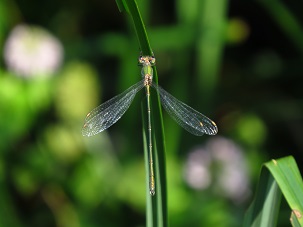 "This is a really exciting find. Willow Emerald Damselflies have been spreading rapidly in south-eastern England since they began to colonise East Anglia from 2009 onwards. Prior to this there had been just three authenticated records (in Kent, Sussex and Suffolk). The species is now established in Essex, Kent, Norfolk and Suffolk and has been found in the London recording area in south-west Essex. On 28th August 2014, an established colony was also discovered near Redhill in Surrey, so there is a potential that there may be overlooked colonies elsewhere.
I can confirm that this record is the first for our county A previous record, involving a specimen of a male supposedly captured on 11th August 1899 by a lake at Shenley by E. R. Speyer, is considered likely to be erroneous as it is thought that the specimen may have been incorrectly labelled and is therefore discounted."
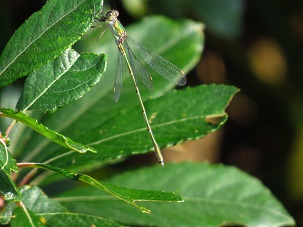 Willow Emerald Damselflies are currently near the peak of their flight season, and can be expected to be flying throughout September, and even as late as November if the weather is suitable so there is plenty of time for more to be found. They can potentially be found at any site where there are water bodies with overhanging trees (especially willows, as the name may suggest!). More about Willow Emeralds and how they are spreading through England on the British Dragonfly Society website.
Darren, who lives close to Amwell, has been an HNHS member for three years and, as he says himself, he has only recently taken an interest in dragonflies. It just shows that you don't have to be very experienced with dragonflies and damselflies to potentially find something unusual, you just need to be observant!
 Congratulations to Darren on his find - where will the next one be found in Hertfordshire?