


One of Hertfordshire?s longest running 'citizen science projects' has generated over one million records of moths in the county.
'Citizen Science' allows anyone with an interest to have direct involvement in serious scientific projects.
?Our one millionth moth was contributed by Graeme Smith, who found a Hazel Blister Moth (Phyllonorycter coryli), hibernating in equipment storage bins at Hayter?s Lawnmowers in Spellbrook, where he runs the paint shop.
Graeme was presented with a special award by Dr Ronni Edmonds-Brown, chair of the Herts Natural History Society, at the Herts Moth Group?s annual meeting on Saturday 22 March at the Havers Community Centre, Havers Lane, Bishops Stortford.
Graeme Smith, said:
'I have always taken an interest in wildlife and find moths, with their seemingly endless array of shapes and colours, a fascinating subject. Since moving to Hertfordshire in 2001, I have found it hard not to be amazed at these wonders which lie, mostly undetected, on our very own doorstep'.
Hertfordshire County Recorder Colin W. Plant FRES, FBNA said:
'Given that the National Moth Database, covering 112 recording areas, has roughly 16.6 million moth records, the fact that we have recorded one million on our patch is highly significant. Having such a large (and still increasing) database of records means that we are able to undertake a range of analyses of the information and gain results that stand up to statistical and other scrutiny. The award recognises the sustained efforts made by everyone who has contributed moth records to achieve this total.'
About the Millionth Moth
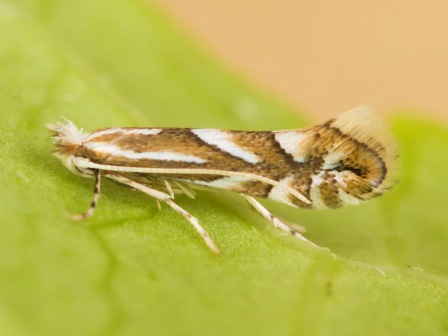 This tiny moth, with a wing-span of only 8mm, about 1/3 inch, is common throughout Hertfordshire and much of the British Isles.
As the name suggests it lives and feeds on Hazel trees.
It is a leaf-mining moth, the larval stages live inside the leaves of trees, burrowing or 'mining' between the upper and lower surface of the leaf creating a distinctive damage patterns.
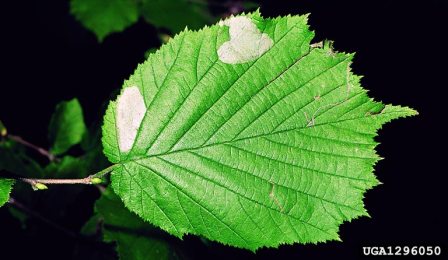
The Hazel Blister moth larva makes distinctive white trails, called 'mines' on the upper surface of Hazel leaves causing the leaf to distort, especially if close to the edge. These mines are very visible in late summer and autumn in hedges, woodlands and town parks and make this one of the easiest moths to record - it can be seen easily from the car window when driving along country lanes, though it is advisable to stop and check before submitting the record!
The adult moths are at large in May/June and again in August. Some hibernate over winter in adult form, hence the discovery of one in the lawn mower workshop. It has been recorded in the county over 200 times before.
This award celebrates the enormous value of contributions made by ordinary people to serious environmental research.
There are approximately 2600 different kinds (species) of moths in Great Britain; of these Hertfordshire boasts 1600 (a little over 60%).
Moth recording in Hertfordshire has been coordinated for over 130 years, by the Hertfordshire Natural History Society. The first/earliest record was also a micro-moth, the locally rare Exapate congelatella, collected on 27 December 1822 in All Saints Churchyard, Hertford.
Modern information on Hertfordshire moths is gathered almost exclusively by amateur naturalists and ordinary members of the public who collectively form The Herts Moth Group.
The Herts Moth Group is run by the County Moth Recorder ? a post that is elected annually by the Hertfordshire Natural History Society. Colin Plant has been the County Moth Recorder since 1987.
The County Moth Recorder?s (entirely voluntary) job is to analyse the moth data provided by ordinary citizens. In this he receives crucial computer support from Andrew Wood. This provides critical information on threatened and endangered species and their habitats and also provides a monitor of a wide range of other environmental issues, including climate change.
Records are transferred to and held by the new Hertfordshire Environmental Records Centre, now located at Herts and Middlesex Wildlife Trust. County data is also fed to a national database at Butterfly Conservation in Dorset where it is combined with data from ordinary people across the whole of the UK.
Our hardbound book The Moths of Hertfordshire, published in 2008, provides a detailed account of the history, status, distribution and phenology of all species known in the county at that date. To buy a copy see here.